
Aug 08
Be wary of canned compressed air
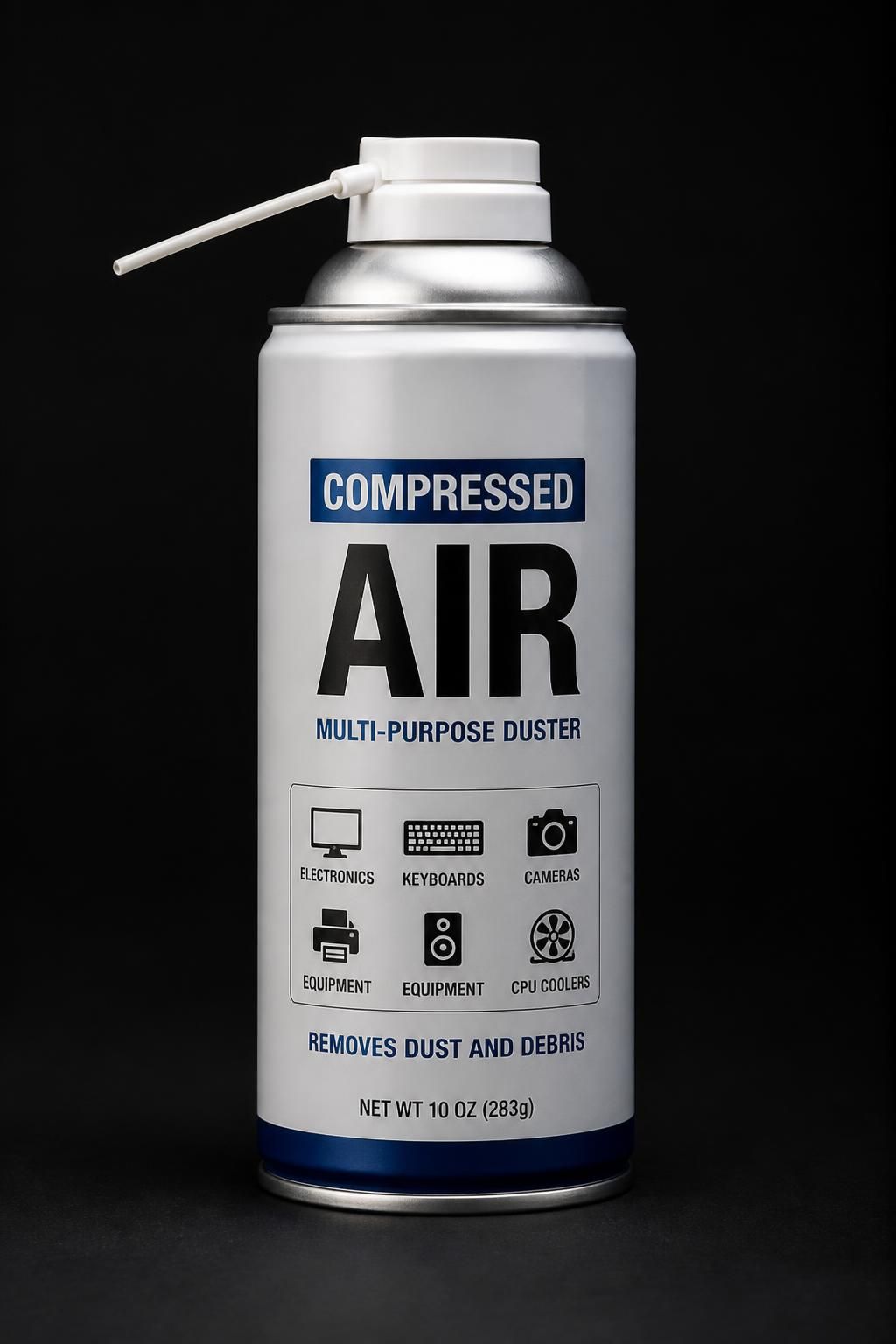
or, the truth about canned compressed air and why there’s no air inside - and where hidden dangers lurk..
You can find them at hardware stores or in the DIY sections of supermarkets and camping shops. And you might often wonder just how expensive bottled air can be - a single can often costs around €8 or more.
But is there actually air inside? When you use the sprays, the air "shimmers," and it doesn't smell like air at all - it smells more like a gas lighter…
Why Real Air Doesn't Fit in Cans
The reason is simple: Real air cannot be liquified in a metal can at room temperature. It can only be compressed in its gaseous state. Consequently, a standard spray can filled with real compressed air would be completely empty after just 2 or 3 seconds of continuous spraying.
That is why liquified gases are used. These liquified gases gradually evaporate inside the can, allowing the spray to deliver consistent pressure for minutes on end.
A quick tip: Here’s an interesting hack to test this yourself - if you turn the can upside down while spraying, the propellant comes out as a liquid. It instantly draws heat from its surroundings, cooling down to as low as -50°C. This can actually be useful - for instance, as a freeze spray (e.g., for troubleshooting circuit boards).
So, What’s Actually Inside?
Most inexpensive cans contain the same gases found in deodorant cans or camping gas cartridges: propane, butane, and isobutane.
- Advantage: Very low price and high pressure.
- Disadvantage: As we all know, these substances are highly flammable!
These sprays must never be used on warm electrical devices that are switched on. Sparks - which may occur in electronic devices, power supplies, switches - can trigger flare-ups or small explosions. Think of it like a makeshift flamethrower made from a deodorant can - we’ve all been there, I guess...
The professional alternative and its pitfalls
The alleged "professional version" of canned "compressed air" - used for tasks involving circuit boards, servers, or live equipment - consists of fluorinated gases (specialty refrigerants). These are non-flammable. Examples include:
- HFO-1234ze (tetrafluoropropene): Used in modern, non-flammable compressed air sprays. It is extremely eco-friendly, as it has a negligible impact on the climate (GWP < 1).
- HFC-134a or HFC-152a: Older fluorinated gases. HFC-134a is completely non-flammable but is being phased out rapidly due to its high global warming potential (climate impact). HFC-152a is difficult to ignite but is significantly cheaper.
But here is the catch: These HFO and HFC gases are non-flammable only at room temperature! The word "non-flammable" on the packaging is actually extremely misleading in this context, lulling the user into a false sense of security.
In chemical terms and safety data sheets, HFO-1234ze (technically: trans-1,3,3,3-tetrafluoropropene) is classified as "non-flammable" at room temperature (20°C) because it does not sustain a flame under standard conditions. However, in a professional work environment—around soldering irons, hot resistors, power electronics, or engine parts—the situation is entirely different.
The hidden danger above 30°C
- It can burn: If the ambient temperature rises above 30°C, HFO-1234ze suddenly becomes flammable. It then forms ignitable mixtures with the air.
- "Thermal breakdown" (thermal decomposition): If the gas comes into contact with glowing-hot surfaces (e.g., a soldering iron at 350°C) or an electric spark, it may not burn spectacularly with a massive flare-up, but it undergoes invisible decomposition.
Why this is so dangerous in professional settings
When the gas decomposes on hot components, highly toxic breakdown products are formed—most notably hydrogen fluoride (HF) and carbonyl fluoride (a relative of the chemical warfare agent phosgene! Yikes!!).
So, the hidden dangers (the insidious aspect) of this:
- No warning: The chemical breakdown is invisible.
- Immediate chemical burns: If these invisible vapors are inhaled, the gas instantly reacts with moisture in the lungs to form hydrofluoric acid. Hydrofluoric acid is an extremely potent contact poison. This leads to severe chemical burns in the respiratory tract (pulmonary edema).
What do professionals use instead?
When working on equipment that is hot or live (posing a risk of sparks), professionals usually turn to alternatives such as:
- CO₂ sprays (carbon dioxide): Completely non-flammable, non-reactive on hot surfaces, and leaves no residue.
- Compressed nitrogen (N₂): Also completely inert and perfectly safe for use on red-hot components.
- Battery-powered electric blowers: For simple dust removal, they completely eliminating the risks associated with gas.
The subsequent environmental issue
Furthermore: While HFO-1234ze does not damage the ozone layer and has a negligible global warming potential (GWP below 1), the gas eventually breaks down in the atmosphere into trifluoroacetic acid (TFA). TFA is a so-called "forever chemical" (PFAS); it enters our groundwater via rainfall, accumulates there permanently, and is classified as hazardous to water.
Conclusion
So, always read the label on the can! With HFO and HFC variants, it is best to leave the product on the shelf - thereby encouraging the supplier to withdraw it from the market.
Whenever possible, use a blower or an air compressor for genuine compressed air. Your local car workshop knows what it’s doing by keeping an air hose handy instead of a spray can.